The knowns and unknowns framework for design thinking
From Ibn Yamin to NASA and Donald Rumsfeld: a short history of the Knowns and Unknowns framework, and how to use it in Design Thinking to surface everything a team knows, and doesn't.
On the 12th of February 2002, Donald Rumsfeld, back then Secretary of Defense of the US, used an until then little known framework to help him in making the case for the invasion of Iraq: the Knowns and Unknowns framework. I think it is fair to say that the reception by the press was mixed: some accused him of playing with words with little meaning, while others saw some method in what he was trying to do.
Rumsfeld’s words have been turned into a poem, written by an unknown poet (very appropriately!) and included in a collection of poems all based on speeches by Donald Rumsfeld, Pieces of Intelligence, by Hart Seely (here in an edited version by Daase and Kessler):
As we know,
There are known knowns.
There are things we know we know.
We also know
There are known unknowns.
That is to say
We know there are some things
We do not know.
But there are also unknown unknowns,
The ones we don’t know
We do not know.
Finally, there are unknown knowns
The knowns
We do not want to know.
What is it?
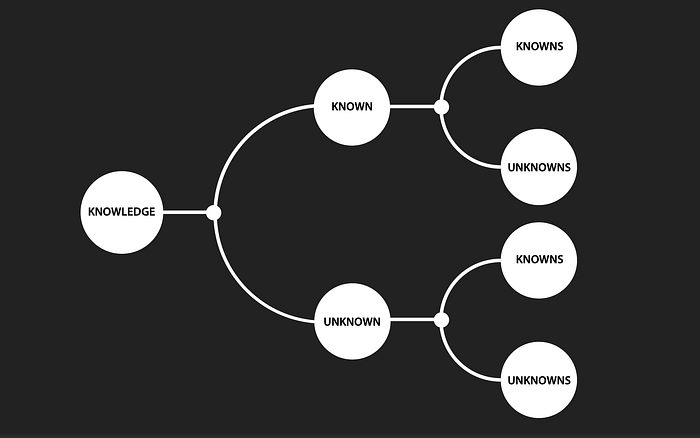
The Knowns and Unknowns categorisation has been used since the Greek era and in many areas of knowledge. It is a powerful tool to surface what we know and don’t know about a problem.
The apparent simplicity of the Knowns and Unknowns framework is deceiving: it can bite us and get people thinking that we are just playing with words, as happened to Rumsfeld. So you’ve been warned, be careful with it. And don’t let it into the hands of war seekers.
The framework can help us to understand our approach to knowledge, to research: What do we know already (known knowns)? Are we conscious of what we are not exploring and what might come unexpectedly (unknown unknowns)? What about biases and unconscious decisions (unknown knowns)? Are we aware of our assumptions (known unknowns)?
The known and the unknown have to be treated in very different ways. We need to adapt our methods to the type of knowledge (including our lack of knowledge, which is also knowledge, if we are aware of it).
If we are working with our unknowns (the Unknown Knowns or the Unknown Unknowns) we need to use exploratory techniques: How might we surface some of those unknowns? How might we prepare for the surprises ahead?
If instead we are investigating what we already know about a problem (the Known Knowns or the Known Unknowns) we have to work in an inductive way: how might we use those facts to learn new things? How might we test our hypotheses?
We will explore some ways of making sure that we take all our knowledge and lack of it into account as part of our research or Design Thinking methods. Before that, I have a few interesting stories about this framework.
Where did it come from?
One could argue that Socrates was using it indirectly when he said “I only know that I don’t know anything” (according to Plato, as with all our "knowledge" of Socrates, which makes this knowledge fall into which bucket? A type of Unknown Known perhaps?). But the first systematic use of the method comes much later, in the fourteenth century, by the Persian poet Ibn Yamin. This is how he categorised human beings according to their knowledge:
One who knows and knows that he knows… his horse of wisdom will reach the skies.
One who knows, but doesn’t know that he knows… he is fast asleep, so you should wake him up!
One who doesn’t know, but knows that he doesn’t know… his limping mule will eventually get him home.
One who doesn’t know and doesn’t know that he doesn’t know… he will be eternally lost in his hopeless oblivion!
He tells us that the act of acquiring knowledge is as important as what we already know.
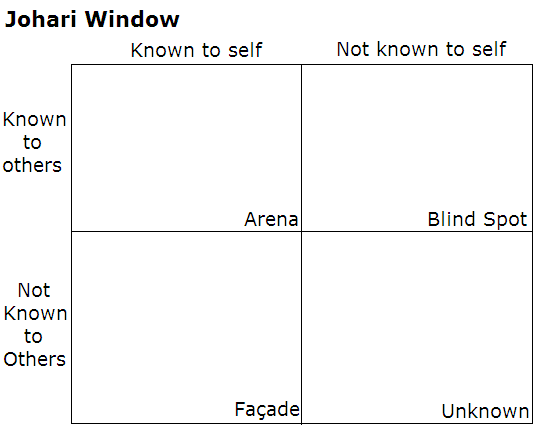
The Johari Window. Diagram by Simon Shek — http://en.wikipedia.org/wiki/Image:Johari_Window.PNG

In the 1950s two psychologists, Joseph Luft and Harrington Ingham, developed the Johari Window, a method to help people evaluate what they think about themselves in contrast with what others think of them. A Blind Spot, for instance, is something that we don’t know or think about ourselves but others do see in us. As a side note, the method uses adjective cards similar to those used in usability evaluation tools like Microsoft’s Reaction Cards.
The link between NASA, Rumsfeld and the Unknown
A few decades later, NASA reported that they were using the framework as part of risk analysis in space missions, especially to uncover Unknown Unknowns. In a presentation from 2003, we can see how they used the framework to evaluate the risks in the return journey of the Space Shuttle. They focus on moving the unknowns into the known realm.
Donald Rumsfeld re-appears in this short history of the Knowns and Unknowns: it is believed that it was a senior engineer from NASA that told Rumsfeld about the framework before he made use of it in the famous press conference in 2002. Rumsfeld certainly made the framework more popular than NASA, for good or bad.
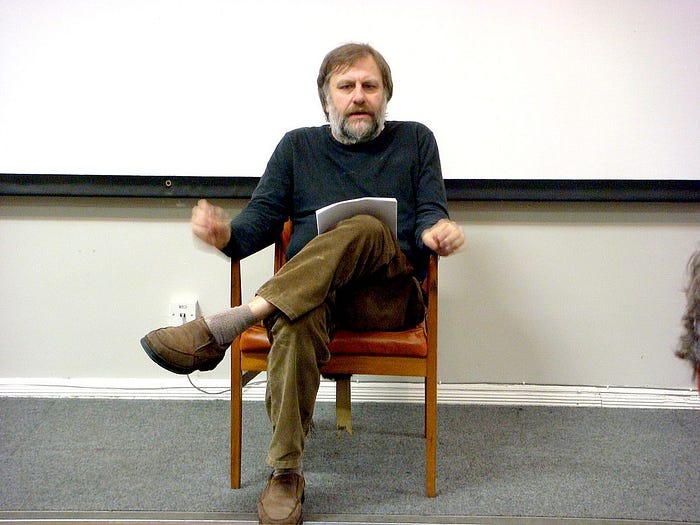
Slavoj Zizek. Photo by Andy Miah — originally posted to Flickr as Slavoj Zizek in Liverpool, CC BY-SA 2.0, https://commons.wikimedia.org/w/index.php?curid=3858994
The chaos and the bees
Slavoj Zizek is a Slovenian philosopher well known for his controversial statements, like this one: “We are all basically evil, egotistical, disgusting”. He also has something to say about our framework. In his article “Rumsfeld and the bees”, Zizek tells us that the most important category of knowledge for humanity is the Unknown Knowns: those things that we know but remain hidden as unconscious biases and prejudices that we are not aware of when making decisions. He gives the example of Climate Change: we all know it is happening, but we fail to act on it on our daily decisions.
Using the framework in Design Thinking
Scientific research often ignores what it cannot observe, that is our Unknown Unknowns. Researchers don’t usually gather data in order to just explore it. Most often, a theory of some sort is already on the table before observations or measurements begin. Theories are often built based on previous knowledge, inferred, not observed. This leads to incremental improvements, but it cannot take you to a big leap in discovery. The unknown can take you there.
At its core, the way of using the Knowns and Unknowns in Design Thinking is simply as a reminder to take all forms of knowledge into account. By doing this, we make the problem space larger and so the solution space also becomes larger. There are many possible ways of doing this. The techniques themselves are not new. The power comes from using a combination that allows you to surface all knowledge and lack of it. These are some possibilities (please note that the suggestions below are meant only as starting points, there is no single or best way of interpreting and using this framework).
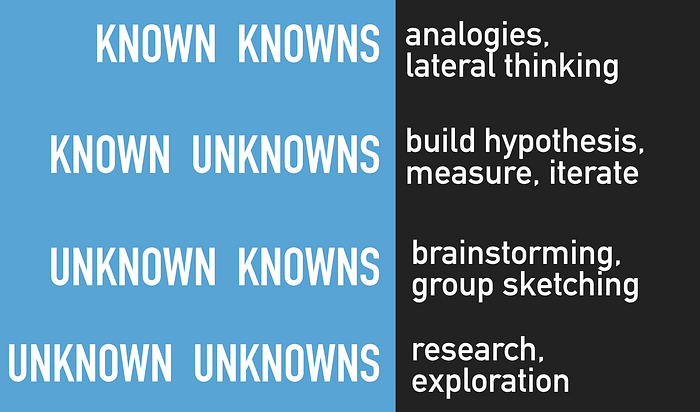
Design Thinking techniques that can be used to surface the different types of knowledge.
Unknown Unknowns
To surface the Unknown Unknowns you need to explore a problem with an open mind. In user research and design research, the interviews that are often conducted at the formative stages of a project can surface these unknowns. As an example, in a recent project we discovered that some users were creating innovative workflows with external tools in order to solve their very unique problems. That is the kind of insight that takes you on big leaps to understanding the problems and to creating products that solve them.
Unknown knowns
This knowledge can be thought of in different ways. We noted above how Ibn Yamin interpreted it, in his categorisation of people, as: One who knows, but doesn’t know that he knows… he is fast asleep, so you should wake him up!. For our aims, I am taking Unknown Knowns to be the unconscious knowledge and unsurfaced bias in a team.
To surface this knowledge, we need to get people to speak their thoughts aloud without too much thinking, as in automatic writing or visual automatism. Brainstorming can be a way to do this in a group. The presence of a group is important, because something that a person says serves as the catapult for others to surface related facts, but the group needs to trust each other in order to feel that they can say whatever comes first to their mind. Group sketching and other ways of rapid collective collaboration can also work towards uncovering Unknown Knowns.
Known Unknowns
With the Known Unknowns we want to create hypotheses. In a Design Thinking or UCD context this usually translates into framing problems as possible solutions in How Might We statements, then creating quick sketches or diagrams for them. We need to pass those ideas through the sieve of testing with users, and for that, formulating hypotheses makes it easier to focus our testing.
Known knowns
Facts are Known Knowns. With them we generate more knowledge. Lateral thinking techniques, like analogies, allow us to see those knowns in a different light, to create a parallel reality from the one you know. The goal is to break with convention, to create something valuable and original from something (facts) that is probably not that valuable, because it is already being exploited.
Give it a try
I have been using this framework for years now, both for personal problems and work projects. I believe that, like other Design Thinking techniques, it opens up possibilities and forces us to think more holistically. It makes a good starting point when exploring any problem and a proven way of analysing our knowledge.